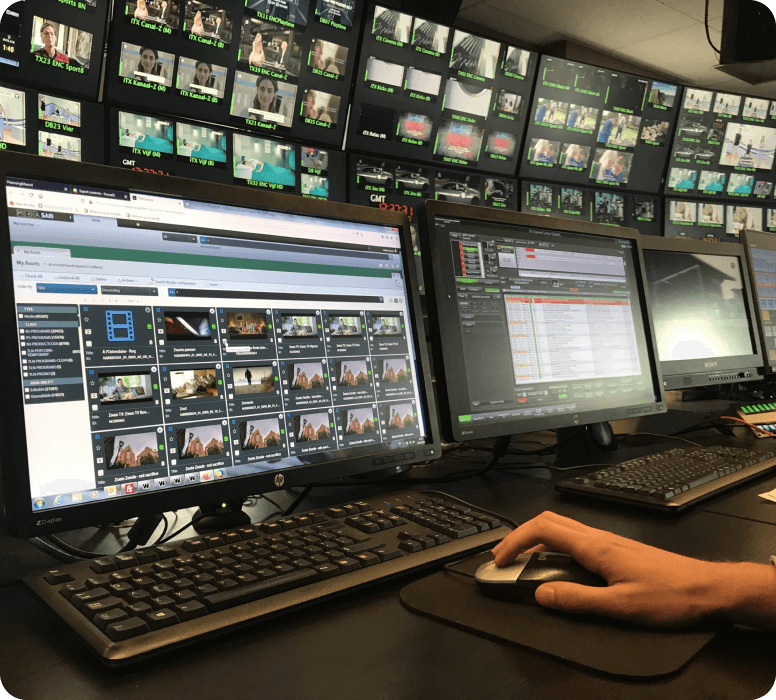
Every four years, the FIFA World Cup becomes the biggest stress test for broadcasters worldwide.
Millions of viewers tune in simultaneously. Thousands of content assets are created daily. Production teams work across multiple time zones, while content must be distributed instantly to television, streaming platforms, websites and social media channels.
But here's a more interesting question:
What if the World Cup never ended?
For many broadcasters, that's exactly what's happening.
The demands traditionally associated with major sporting events are becoming the new normal. Audiences expect content to be available immediately, everywhere and in every format.
The future of sports broadcasting is not about handling occasional spikes in demand. It's about operating in "World Cup mode" every day.
Why Sports Broadcasting Has Become More Complex Than Ever
Sports broadcasters are no longer simply delivering live matches to television audiences.
Today, they are running large-scale content operations.
A single sporting event can generate:
Live broadcast feeds
Multi-camera recordings
Social media clips
Short-form vertical videos
Real-time highlights
Multilingual versions
Promotional content
Archived assets for future reuse
Each piece of content has its own lifecycle and distribution requirements.
The challenge is no longer content creation.
The challenge is managing content efficiently.
What Is a Sports Broadcasting Workflow?
A sports broadcasting workflow is the process that allows media organizations to ingest, manage, enrich, edit, distribute and archive content across multiple platforms.
Modern sports broadcasting workflows typically include:
Live content ingestion
Media asset management (MAM)
Metadata enrichment
Content editing and approval
Multi-platform distribution
Long-term archiving
When these systems are disconnected, operations become slower, more expensive and difficult to scale.
The Hidden Problem: Content Velocity
The speed at which content moves has become a critical operational challenge.
For example, a goal scored during a match may need to be:
Clipped within seconds
Published on social media immediately
Distributed to digital platforms
Sent to regional teams
Archived for future use
This process often happens simultaneously.
Organizations that still rely on manual workflows struggle to keep pace.
The result is duplicated work, inconsistent metadata and delays in content delivery.
Why Media Workflow Management Is Becoming a Competitive Advantage
Broadcasters are realizing that technology infrastructure directly impacts audience engagement.
Efficient media workflow management allows organizations to:
Centralize content
Teams can access media assets from a single ecosystem instead of searching across multiple systems.
Automate repetitive tasks
Artificial intelligence and automation can accelerate metadata generation, speech-to-text transcription and content categorization.
Improve collaboration
Editorial, production and digital teams can work from the same source of truth.
Scale operations faster
Organizations can respond to audience peaks without adding unnecessary complexity.
Increase content monetization opportunities
The easier it is to find, repurpose and distribute content, the greater its commercial value.
Why the World Cup Is a Glimpse Into the Future of Broadcasting
The World Cup is no longer an exceptional event.
It is a preview of where the entire industry is heading.
Streaming platforms, social media and digital audiences have permanently changed consumption habits.
Broadcasters are expected to deliver:
More content
Faster content
Personalized content
Multi-platform experiences
Global accessibility
The organizations that succeed will not necessarily be the ones producing more content.
They will be the ones orchestrating content more intelligently.
Five Questions Every Broadcaster Should Ask
As audience expectations continue to evolve, every media organization should ask:
Can our teams find content in seconds?
Can our workflows scale during peak demand?
Can we distribute content to multiple platforms simultaneously?
Can we automate repetitive tasks?
Can our archive become a strategic production asset?
If the answer to any of these questions is no, the infrastructure may not be ready for the future of sports broadcasting.
The Future Belongs to Connected Media Ecosystems
The next generation of broadcasters will not be defined by their ability to produce content.
They will be defined by their ability to connect systems, automate workflows and orchestrate content at scale.
Because audiences no longer experience broadcasting as a single event.
They experience an always-on ecosystem.
And that means broadcasters can no longer prepare for occasional moments of peak demand.
They must be ready to operate in World Cup mode every day.
At VSN, we believe that building connected, scalable and future-ready media ecosystems is the key to enabling broadcasters to grow without adding operational complexity.
Because in modern broadcasting, speed is no longer the advantage.
Connected workflows are.